Aiena urges lawmakers to strengthen primary care, preserve physician independence
By Jonathan Nelson
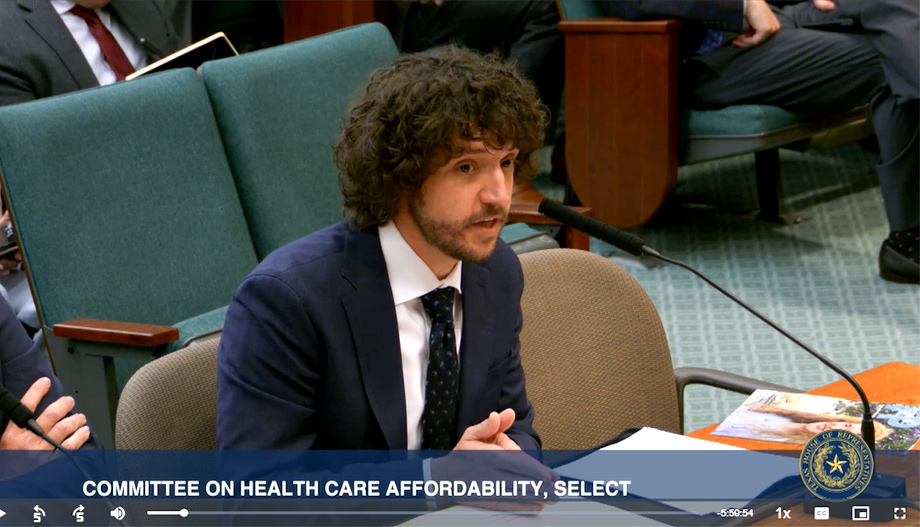
TAFP Parliamentarian Lane Aiena, MD, testified Tuesday before the Texas House Select Committee on Health Care Affordability, urging lawmakers to consider policies that strengthen independent physician practices, improve competition, and make health care more affordable for patients.
Aiena, a family physician in Huntsville, told committee members that he sees the effects of rising health care costs every day in his practice, at the pharmacy, and in conversations with patients and local employers.
“Medicare, Medicaid, and commercial insurance payments have not kept pace with these practice costs,” Aiena said, adding that the costs of staffing, technology, supplies, and compliance continue to rise. “Prior authorization, documentation, and other administrative burdens keep taking more time and more money away from us, which takes time away from patients.”
Aiena practices in a five-physician independent primary care group serving more than 10,000 patients in Walker County and surrounding communities. He told lawmakers that independent practices face the same rising costs as larger health systems but do not have the same administrative infrastructure, scale, or bargaining power.
“For many independent physicians, selling your practice is not a fun decision,” he said. “It’s a financial survivability decision, and that’s not what’s good for the patients of Texas.”
At the center of TAFP’s testimony was a simple argument: independent physicians are not the cause of the affordability problem, but they can be part of the solution. Independent practices, he said, preserve patient choice, remain closely connected to their communities, and provide meaningful competition.
TAFP asked lawmakers to focus on six policy priorities.
- Make cost and quality information usable. Texas should make better use of the Texas All-Payer Claims Database and consider creating a Health Care Affordability Office within the Comptroller’s office to turn existing data into accessible cost-and-quality information for patients, employers, clinicians, and policymakers.
- Support and fund health care navigators. Patients need neutral assistance understanding provider networks, deductibles, copayments, coinsurance, prior authorization requirements, and other complexities of health coverage.
- Reduce and standardize administrative requirements. TAFP supports reforms including streamlined credentialing, less duplicative documentation, more standardized quality reporting, and reductions in low-value prior authorization.
- Adopt targeted site-neutral payment policies. Comparable routine outpatient services should not cost more simply because a hospital system owns the facility or practice providing them.
- Use Texas’ purchasing power. State employee and educator health plans could be used to test payment models that better support primary care, including predictable per-member, per-month payments tied to measurable results.
- Make primary care sustainable. Texas should recognize and support the work family physicians do between visits — managing chronic disease, coordinating care, following up with patients, and preventing avoidable emergency department visits and hospitalizations.
Aiena emphasized the final point with examples from his own practice.
“Primary care happens when I’m making sure diabetes doesn’t become an [hospital] admission, when I’m making sure hypertension doesn’t become a stroke,” he said.
“Texas should pay primary care not only for those visits, but for the costly problems it helps avoid,” Aiena said.
He closed by reminding lawmakers that while Texas cannot control every factor driving health care costs, the state still has meaningful policy options available.
“Texas is not powerless,” Aiena said. “There are levers we can pull and there are smart ways we can spend this money to preserve patient choice, empower the patient, and make sure that primary care is strong.”
TAFP’s complete written testimony provides additional detail on each of the association’s recommendations.