MEMBER VOICES: Healing our fractured health care system
The inaugural address of TAFP’s newly inducted president, Ike Okwuwa, MD
By Ike Okwuwa, MD
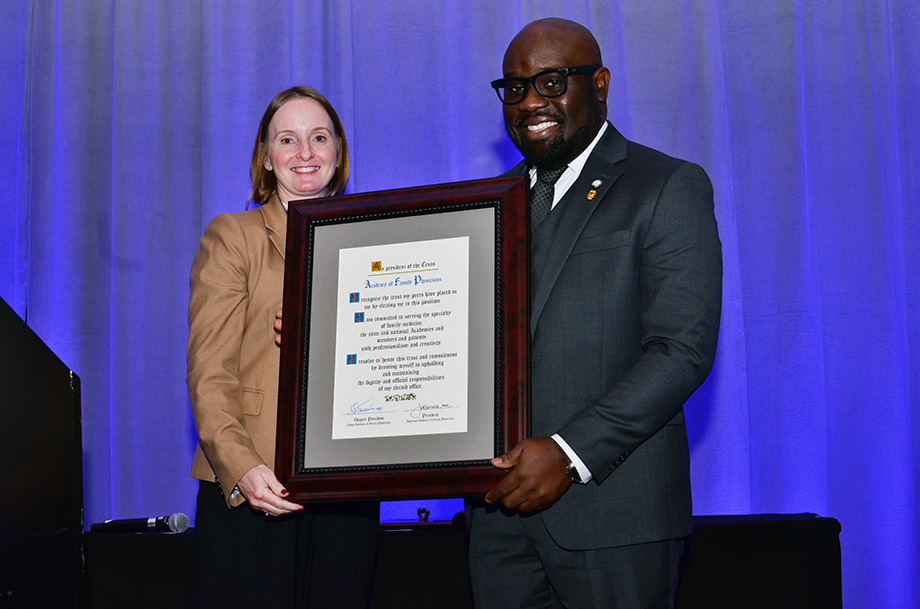
Greetings, colleagues. I’m truly honored to begin my service as your next president. It’s been over two decades since someone from my neck of the woods in the Permian Basin has had the privilege to lead this great organization. I say this not as a statement of pride, but with deep appreciation, because I stand here on the shoulders of giants who have come before me — mentors, friends, colleagues, and family who have supported and shaped my journey.
The Texas Academy of Family Physicians has never been just an organization to me. It has always felt like family. It has been my community, united not only by our professional calling, but by a sense of shared purpose. We believe medicine is more than the treatment of illness. I can say that family physicians orchestrate the perfect blend of the art and science of caring for people and positively impacting the health and well-being of our communities.
We don’t need to be reminded that medicine is constantly evolving, and recently, the pace has been astronomical. With the advent of digital transformation, AI, machine learning, and new technologies, we are faced with an increasing number of rules, guidelines, regulations, and metrics that permeate our daily work, creating an exhausting feeling of non-stop pressure and noise that never seems to cease. Yet through it all, one truth endures: our patients want a personal relationship with a family physician.
Over the past eight years, as program director of the Family Medicine Residency Program at Texas Tech University Health Sciences Center in the Permian Basin, I have asked countless students, residency applicants, and residents why they chose a career in medicine. In whatever variation the answer comes in, it can be summarized as this: to take care of people. Not for prestige, or wealth, power, or status, but to care for people!
The answer never gets old. It always reminds me that at its core, the practice of medicine is about people. Each of us entered this noble profession for a simple, profound reason: because we care about people. With over 8.2 billion people on the planet today, the question then remains: Are we doing what brought us into medicine in the first place? Are we living our “why”?
Our patients seek more than a clinician. They seek someone who knows them, listens to them, and who stands by them through life’s ups and downs. They need someone who sees them, not through the lens of arbitrary labels we place on people, but who truly sees them for who they are — human beings first. This is the humanity at the core of medicine. If we hope to “heal” our health care system, we need to bring humanity back into the practice of medicine.
Somewhere along the way, our current health care system has forgotten the people part of medicine. The relentless focus on productivity metrics, billing and coding pressures, and administrative demands has all but squeezed the joy out of our work, pulling us away from the bedside and our own sense of purpose. It has left too many of us feeling exhausted, disillusioned, and even morally and emotionally wounded.
So, bringing humanity back to medicine is not a catchphrase or slogan to me. It is an act of courage. It is a conscious decision, every day, to resist distraction and noise around us and reclaim what matters most. It means looking up from the EHR to meet a patient’s eyes, holding a worried hand, and listening — truly listening — to the story beneath their symptoms. It is serving patients not as problems to be fixed, but as people to cherish. And just as we give our all in the service of others, we should also remember that we are also human beings, and our health and well-being are important. We, too, need grace, rest, and community to be at our best.
Too often, our payment system still rewards and prioritizes volume over value and quantity over quality. We are long past overdue for a change in this system…. Healing our health care system starts by valuing those who heal.
As family physicians, we are uniquely called to lead this revolution. No other discipline walks with patients and families throughout their lifetime. Our gifts, the gifts of first contact, continuity, coordination, and comprehensiveness, are our superpowers. We must reclaim the truth that these four Cs of primary care and the deep relations we build with our patients are not luxuries. They are the foundation of better outcomes, lower costs, and deeper trust.
Yet, too often, our payment system still rewards and prioritizes volume over value and quantity over quality. We are long past overdue for a change in this system. If we are to heal our health care system, we must continue to boldly and persistently advocate for payment systems that value the work we do as family physicians, and the time, trust, and the sacred bond between doctor and patient. That means advocating for models that reward relationship-based care, investing in robust primary care infrastructure as the foundation of our health care delivery, and challenging the forces that turn healing into mere commerce, ensuring that our work is fairly valued and sustainably supported. Healing our health care system starts by valuing those who heal.
But our responsibility does not end with systems change. We also have a moral duty to nurture and inspire the next generation of family physicians. Those who know me know that my career has been in academic medicine. Working with my colleagues to expand primary care access to the people of the Permian Basin through our residency program that spans over eight counties. Our focus has been on training competent and compassionate family medicine resident physicians who would have a positive impact in any community they serve. The future of our specialty depends on whether today’s medical students and residents see family medicine not only as a viable career but also as a calling. They must see that the heart of our work is not just found in prior authorizations or performance metrics, but in building authentic relationships that heal and endure. They need our teaching, encouragement, mentorship, and most importantly, our example.
As a program director, I still see firsthand the hope and idealism in our trainees. They still believe medicine can be both noble and humane, and we must prove them right. That means not only modeling compassion and integrity but also preparing them for a future shaped by innovation. As digital transformation continues to sweep across all industries, including health care, we must proactively start training our medical students and residents to become digitally fluent physicians who can harness technology without losing humanity, and use AI to enhance care, not replace connection. These digital tools may evolve, but the core mission — to care for people — remains unchanged.
Medical students and residents need to know that we value them and that we will fight for the conditions that allow them to practice with joy, purpose, and balance. Aligning with the leadership law of the picture, our actions — not mere words — are the most powerful teaching tools. So, let us continue to model what we teach and show them the true pluripotent practice potential of our specialty, and that family medicine remains the beating heart of a compassionate health care system.
Finally, as we navigate the challenges ahead including workforce shortages, particularly in rural areas, scope of practice issues, regulatory changes, and policy reforms, it is imperative, now more than ever, for us to hold fast to respectful dialogue. At TAFP, our mission is to promote the health of all Texans by serving the needs of members and advancing the specialty of family medicine. However, we live in an era that is marked by profound division and discord. In the world today, it feels like we are constantly talking, yet not listening to each other.
The strength of TAFP lies in its members. We must continue to strengthen the bonds that unite us and be examples of civility and collaboration. We can engage policymakers, payers, and partners not as adversaries, but as allies in the shared work of healing a fractured health care system. It is okay that we might, at times, disagree on strategy. However, we can and should always remain united in our purpose, because in the final analysis, it goes back to our “why” as physicians: to care for people. Respectful dialogue does not signal weakness. It speaks to our strength. It is empathy in action. Collaborative dialogue and leadership are what our communities and our country desperately need, and it will truly enable us to move forward together.
My friends, we are stewards of something sacred. Family medicine is more than a specialty; it is a promise. A promise to care for the whole person, to walk alongside people in their health and life journey, and to remind our profession and ourselves that healing always begins with valuing a person’s humanity.
Let us lead with that conviction. Let us advocate with that passion. Let us teach and inspire the next generation of family physicians with compassion, and let us heal not only our patients but also our profession and the fractured health care system. Let us ensure that, throughout Texas and beyond, the heart of medicine continues to beat strong and steady through the work of family physicians like you.
Thank you for your service, your sacrifice, and the hope you bring to this noble calling we share. I look forward to serving you as president of this great organization over the next year.