Member of the Month: Ikemefuna “Ike” Okwuwa, MD
TAFP president excited to further Academy’s mission in upcoming year
By Samantha White
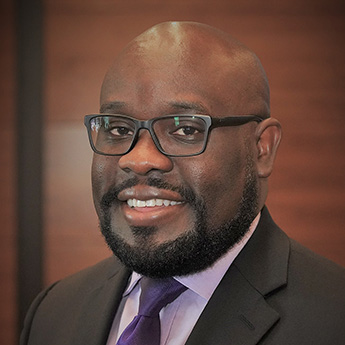
TAFP’s newly installed president, Ike Okwuwa, MD, took a path to family medicine rooted in service, curiosity, and a deep commitment to community. Along the way he found that leadership, mentorship, and advocacy were just as significant for him, so he landed in academic medicine, helping to shape the next generation of family physicians as the family medicine residency program director for the Texas Tech University Health Sciences Center of the Permian Basin. Read Okwuwa’s inaugural address here, delivered at TAFP’s recent Annual Session and Primary Care Summit.
Tell us about your career path into family medicine.
My career has been a steady journey of growth centered on service and purpose. After completing medical school at the University of Benin in Nigeria and residency at Texas Tech University Health Sciences Center of the Permian Basin, I remained in West Texas because I was drawn to the people, the community, and the chance to make a difference. I knew I wanted to play my part in increasing access to care, particularly in rural areas, and in training competent and compassionate family physicians who would make a difference in the communities they served. I did a faculty development fellowship at the University of North Texas in Fort Worth, and stayed on at the residency program where I trained. I am currently completing my MBA at Texas Tech, with a concentration on both health organization management and AI and data science.
Over the years, my growth journey in the residency program included serving initially as the associate program director and chairman of the clinical competency committee. For the past eight years I have served as the program director of a rapidly growing residency program that has expanded from 18 to 69 residents across eight counties in the Permian Basin, including six rural tracks, that remains one of the largest and most innovative training ecosystems for family medicine in our state. Practice-wise, I provide both ambulatory and inpatient care in an academic setting, as well as hyperbaric oxygen therapy at our local hospital.
Leadership and advocacy have also been very important to me, and I have served in various leadership capacities locally, for Texas through TAFP and TMA, and nationally with AAFP. Across my clinical, academic, and administrative roles, I am guided by the belief expressed by Peter Drucker: “Management is doing things right; leadership is doing the right things.” For me, the right thing has always been clear. Build and advocate for systems that value people — patients, learners, and physicians. Every role I have held supports one mission: improving patients' health by strengthening the people and systems that care for them.
Who or what inspired you to become a family physician?
Honestly, when I think back, I chose to become a family physician because I wanted a meaningful life rooted in service, and family medicine provided that space for me. Growing up, a family physician was the “image” I had of what a physician should be – someone who could take care of everyone. Early in life, I was lucky to witness how transformative a caring physician can be. I saw how deeply people’s dignity and hope are tied to being truly seen by their doctor. That connection, which is the perfect blend of science, compassion, and long-term relationships, pulled me toward family medicine. It is a specialty that gave me exactly what I was looking for: the chance to care for people in all aspects of their stories, not just their symptoms.
Throughout my career and personal growth, I have had incredible mentors and teachers who have modeled relationship-centered care with extraordinary humanity. Maya Angelou said it best: “I've learned that people will forget what you said, people will forget what you did, but people will never forget how you made them feel.” Family medicine exemplifies that truth every day, which is why I am aligned with this specialty that champions positive relationships and the hope of bringing humanity back into the practice of medicine.
What ultimately drew you to academics?
The Latin root of doctor, docere, meaning “to teach,” has always resonated deeply with me. Many of us stand where we are today because of teachers who challenged us, stretched our limits, and revealed possibilities we could not yet see. Teaching is also a multiplier because when you teach one person, you plant seeds that can grow into forests of impact. In medicine, teaching one physician well means touching the lives of thousands of patients across a lifetime.
This realization drew me to academic medicine. I wanted to be part of shaping the future, not only by developing others but also by developing myself in the process. Teaching is never a one-way street; it is a symbiotic cycle of empowerment. When you teach, you learn as learners push you to refine your thinking, to stay curious, and to grow. As Sir William Osler once said, “The best teaching is that taught by the patient himself.” In academic medicine, learners (students and resident physicians) and patients together become our greatest teachers, reminding us that humility and curiosity are the foundations of growth, and I am a lifelong learner.
Family medicine, in particular, embodies this calling to teach because we see patients across the lifespan, across settings, and across generations. A family medicine resident trained to listen deeply, to think broadly, and to act wisely will carry those lessons into every exam room, every community meeting, and every leadership role they assume. So, for me, academic medicine is not simply about knowledge transfer; it is about shaping attitudes and identities and empowering physicians to heal individuals and systems. By teaching, we multiply our impact. By mentoring, we shape the future of care. And by embracing family medicine’s breadth and depth, we ensure that tomorrow’s physicians are not only healers of disease but stewards of communities. This is why academic medicine has been my career focus so far.
Why do you choose to be a TAFP member?
TAFP is my professional home. It is family. Here, I found mentors who believed in me, colleagues who inspired me, a community that fights for the soul of family medicine, and a platform to advocate for patient-centered care across Texas.
Since attending my first TAFP conference over 15 years ago, I have witnessed an organization that truly lives its mission: to promote the health of all Texans by serving the needs of its members and advancing our specialty. The camaraderie is genuine, the opportunities to connect and grow are limitless, and the commitment to service is unwavering. Through CME tailored to the realities of our various practices, scholarships, and support that invest in future leaders, including medical students and residents, and staff who tirelessly champion our profession, TAFP has proven that it does more than support us as physicians. It empowers us. Here, you are never just a number. You are part of a community of colleagues united by purpose and passion.
From my earliest leadership roles serving on commissions, committees, and the board, TAFP has shaped me not only as a physician but as a leader. Nelson Mandela once said, “There is no passion to be found in playing small.” TAFP does not play small. It challenges us to think bigger about our purpose, our impact, our health care system, and the role family medicine should have in it. It inspires us to dream beyond the exam room, to advocate for our patients, and to reimagine what family medicine can achieve. TAFP doesn’t just represent us, it amplifies our voice, strengthens our impact, and reminds us that we are part of a movement larger than ourselves. My journey with TAFP has been nothing short of amazing, and I am truly grateful. I choose to be a TAFP member because here, we are building a healthier Texas. TAFP has definitely helped further solidify my love for family medicine.
What made you decide to become a TAFP officer?
Service is at the heart of my leadership philosophy, and serving as a TAFP officer is my way of giving back to the organization that has shaped me into the physician and leader I am today. After years of committee work, program chair roles, leadership development training, and board positions, stepping into an officer leadership role felt more like the natural extension of my commitment to serve, to give back to the organization that has invested in me, and to ensure that family medicine continues to thrive as the cornerstone of health care.
I believe family medicine is the answer to the nation’s health care delivery question. It is the specialty that sees the whole person, the whole family, and the whole community. To lead within TAFP is to champion that vision. As Max De Pree once said, “The first responsibility of a leader is to define reality. The last is to say thank you. In between, the leader is a servant.” My decision to become an officer was rooted in this philosophy of servant leadership, in supporting TAFP’s innovative initiatives, in advocating for our members, and in embodying what family medicine stands for.
As an officer and now president, my mission is clear: to advocate for a health care system that honors the humanity at the core of medicine and values relationships over mere transactions, to support the wellness and resilience of our members, recognizing that caring for those who care for others is essential, to strengthen respectful, united advocacy in divided times, and to ensure that our collective voice remains strong and principled. I am also passionate about adding my quota in training and championing the next generation of family physicians, equipping them with tools that integrate innovation, digital fluency, and systems thinking without ever losing the humanity that defines our specialty.
As John Quincy Adams once said, “If your actions inspire others to dream more, learn more, do more, and become more, you are a leader.” That is the kind of leadership I aspire to bring to TAFP. Leadership that inspires, empowers, and leaves a legacy of health and hope for the next generation of family physicians, and every Texan.
What do you enjoy doing outside of medicine?
Outside of medicine, I am first and foremost a husband and a father. My wife, who is a nephrologist, and our two children are my greatest joy and grounding force. Their laughter, curiosity, and love remind me daily of what truly matters. They are the compass that keeps me centered and the inspiration behind everything I do. Spending time at home with them gives my life meaning.
I am passionate about soccer and proudly support Manchester United FC in the English Premier League. I am an avid reader, drawn to books about leadership and personal development, history, autobiographies, and fiction. Books really sharpen my mind and expand my imagination. I am also a devoted supporter of the arts – local stage dramas, Broadway shows, and operas feed my soul with creativity and storytelling. Music centers me; I somewhat trust my singing voice, though not my dexterity with the guitar and piano. Writing is another personal passion of mine, and I find capturing my thoughts on paper fulfilling, clarifying, and a step toward turning my reflection into action. Traveling and exploring new places enriches me with new perspectives.
Beyond personal pursuits, I find deep fulfillment in mentoring residents and students, helping them achieve their personal and professional goals. Their growth and success are my reward. Public speaking, too, energizes me. It is not just about words, but about connection, about inspiring others to see possibility in themselves.
In all these pursuits, family, sport, art, music, writing, travel, and mentorship, I find balance, renewal, and purpose. They remind me that life is not only about the work we do, but about the joy we cultivate, the people we uplift, and the stories we leave behind.
TAFP’s Member of the Month program highlights Texas family physicians in TAFP News Now and on the TAFP website. We feature a biography and a Q&A with a different TAFP member each month and his or her unique approach to family medicine. If you know an outstanding family physician colleague who you think should be featured as a Member of the Month or if you’d like to tell your own story, nominate yourself or your colleague by contacting TAFP by email at tafp@tafp.org or by phone at (512) 329-8666.